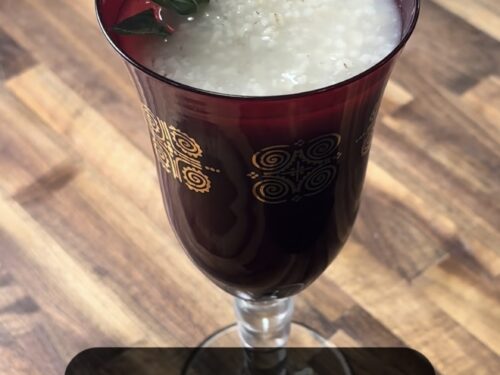
Instructions
Notes
- Pennyroyal mint, the specific variety documented in the Homeric Hymn to Demeter, has a significantly more intense, almost medicinal mint flavour than standard garden mint. It is worth sourcing if you want the most historically precise version. Note that pennyroyal should not be consumed in large quantities as it contains pulegone, which is toxic at high doses. The small amount used as a flavouring in this recipe presents no risk but do not use pennyroyal essential oil as a substitute.
- The honey is an addition drawn from the Odyssey version of kykeon rather than the Hymn to Demeter version, which specifies only barley, water and mint. Adding honey is historically documented in kykeon preparations and makes the drink considerably more palatable. Whether the Eleusinian version contained honey is not known.
- The nine-day fast is the element of context that my kitchen recreation most conspicuously lacked. Every ancient account of the transformative quality of the Eleusinian experience must be understood against the background of nine days of fasting, a twenty-kilometre procession by torchlight, and an intense ritual preparation in a sanctuary that had been operating as one of the most significant religious sites in the ancient world for over a thousand years before the initiate arrived. The kykeon was the final act of that preparation. How it tasted after nine days of fasting, in the middle of the night, in the great hall at Eleusis, surrounded by hundreds of fellow initiates and the full weight of ancient Greek religious culture, is genuinely impossible to replicate in a domestic kitchen on a Tuesday. The 1.8 out of 10 should be understood with that in mind.